不只是 BIPOC 越野跑团:Sin Miedo 社群侧写
More Than a BIPOC Trail Run Club: A Profile of Sin Miedo
Sin Miedo 是田纳西州纳什维尔一个面向 BIPOC 跑者的越野跑社群,由 Yolanda López Haugabook 与丈夫 Antoine 在经历当地越野跑团排外言论后于 2025 年 6 月 1 日正式发起,目前拥有 165 名活跃成员。
The post More Than a BIPOC Trail Run Club: A Profile of Sin Miedo appeared first on iRunFar.
It was, Yolanda López Haugabook remembers, the fourth time at a group trail run in Nashville, Tennessee, when everything changed.
Haugabook and her husband, Antoine Haugabook, had attended the run a few times after Antoine was accepted to the Running Industry Diversity Coalition’s trail running program called Freedom to Run: Back Outside. The couple — experienced road runners embedded in their local communities — plus their friend Gabe Marrero, were relatively new to the trails and excited to see what they were all about.
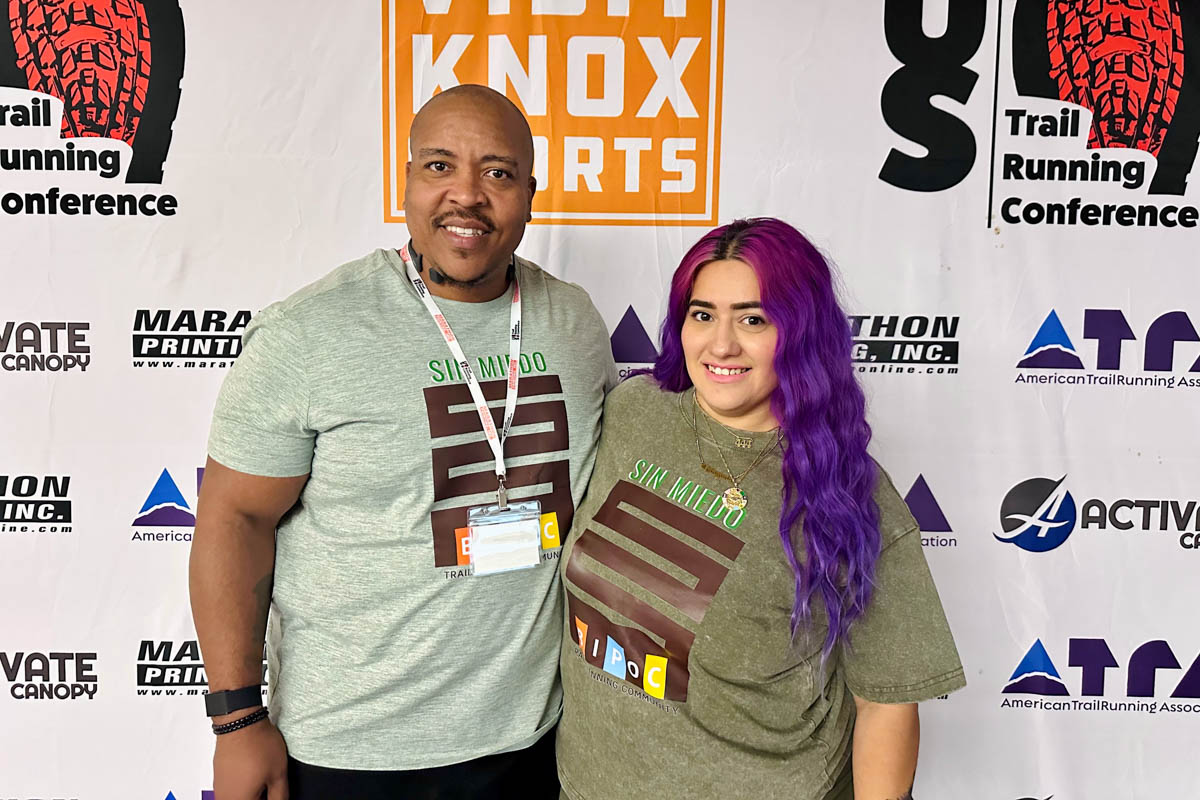
On that fateful fourth run, another runner approached them. “Oh, y’all are back?” he asked the trio. Yolanda can still hear his Southern twang.
“I was excited,” Yolanda said in a recent interview. “Like, wow, they finally realized we were coming this whole time.”
The runner, though, continued. “Y’all ain’t had enough yet?” he asked.
The words hung in the air, heavy with coded meaning. Yolanda is Hispanic. Antoine is Black.
“I was like, what do you mean we haven’t had enough yet?” Yolanda said. “And I was like, ‘And we won’t.’” The interaction lit a fire under Yolanda, who gets an idea and, well, runs with it. Her first race was a marathon. She skipped all of the shorter distances.
The conversation happened on a Thursday. On Sunday, they had organized a trail run with some of their friends. “I looked at Antoine, and he goes, ‘We’re telling them today, aren’t we?’” Yolanda said. “He already knew. We didn’t even speak about it.” Before the run, they proposed their unspoken idea to their friends: If we start a BIPOC trail running group, are you in?
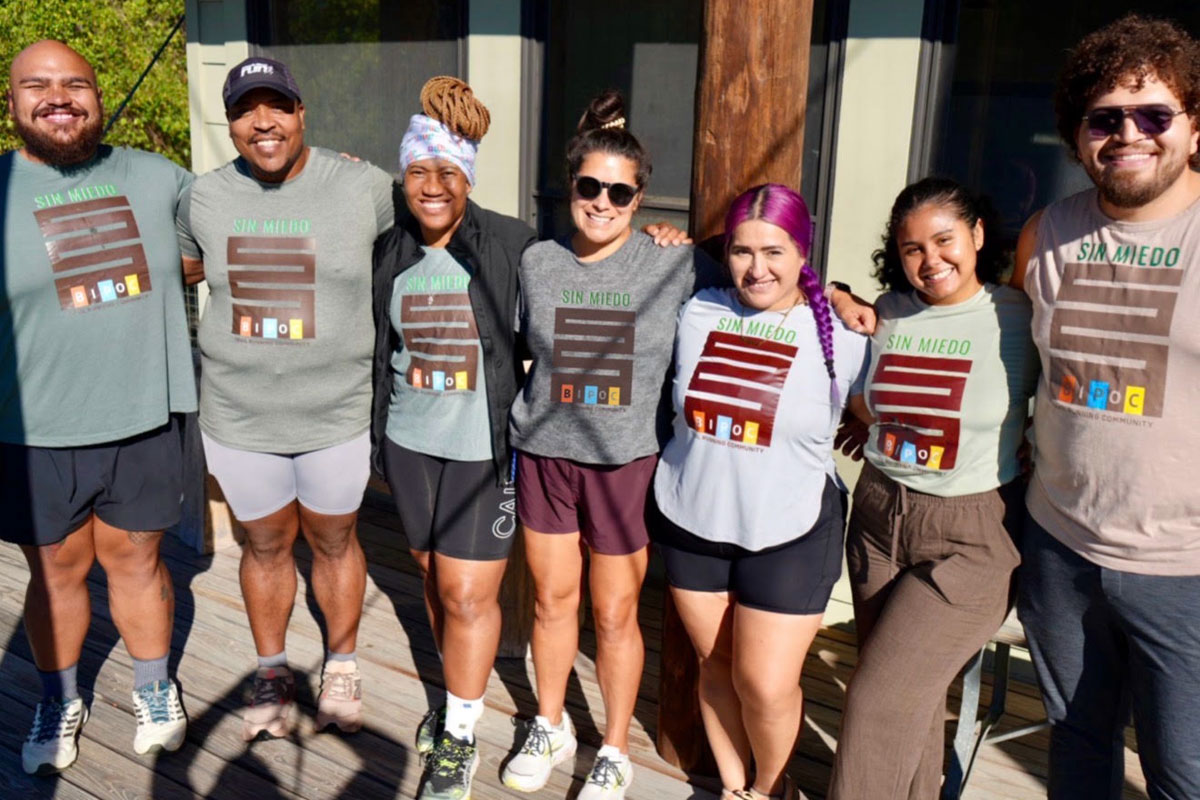
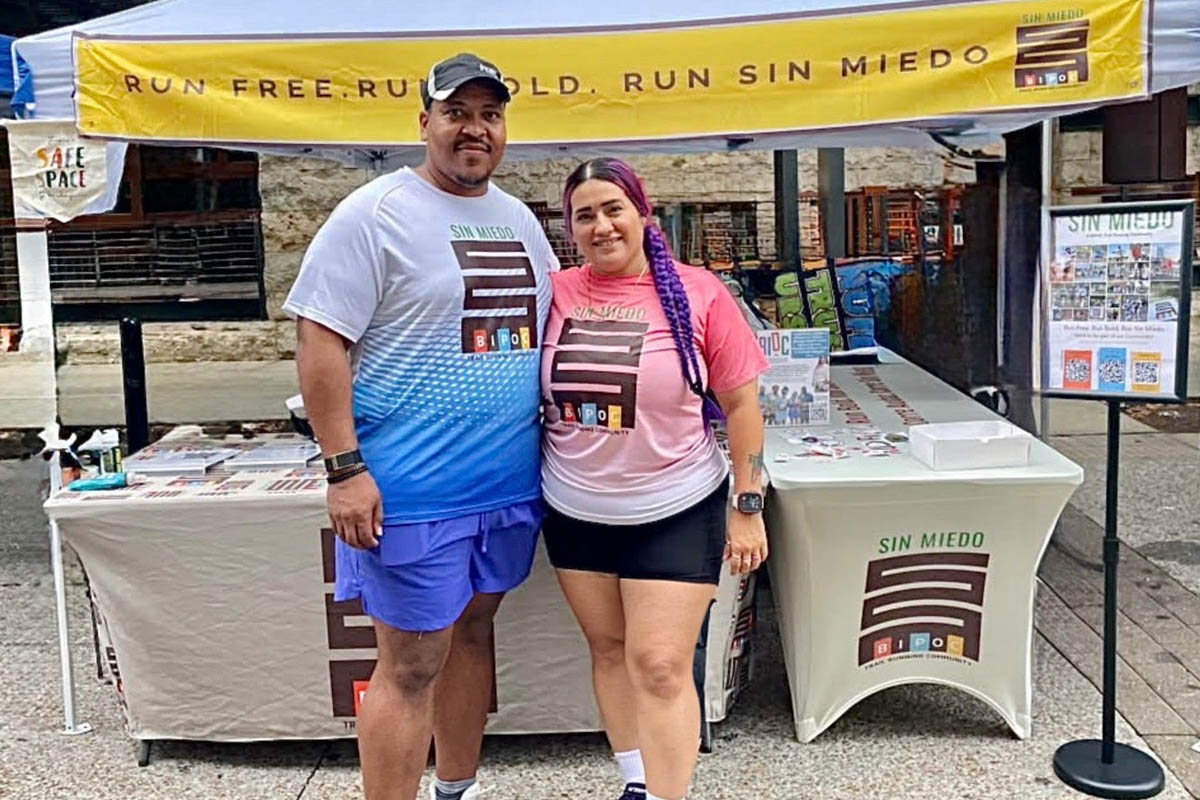
They were. But they perhaps didn’t know the extent to which Yolanda was. By Tuesday, the group had a logo, an Instagram page, a group chat, and community guidelines. “I don’t know what took over me,” Yolanda said. “Just kind of like the marathon: 0 to 100.” The group’s first run was June 1, 2025. Several runners showed up. “And from there, it has not stopped,” Yolanda said.
Sin Miedo was officially born.
Finding Running
The question is posed to Yolanda: How would you describe Sin Miedo to someone who’s never heard of it before?
“Oh man,” she responded. “Without crying, you mean?”
Officially, Sin Miedo is a trail running community — much more than a run club, Yolanda said — for BIPOC runners in Nashville, Tennessee, meeting for weekly group runs and holding other events for its 165 active members. But perhaps to truly understand Sin Miedo, you need to go back to the start. Perhaps you need to first understand the impact that running has had on Yolanda and Antoine’s lives.
Their first date was a run. Yolanda was not a runner. Antoine was.
“I was like, ‘You’re lucky you’re cute,’” Yolanda said. “I still say that to him now. And we kept running and running. Six miles later, ‘I’m like, ‘Ok, guy, you’re not that cute.’”
When they were married, Antoine, a longtime runner who serves as the captain of Black Men Run Nashville, mentioned, in passing, Every Woman’s Marathon in Savannah, Georgia. Yolanda was intrigued. Antoine tried to explain that she should build up to the marathon, maybe doing a 10k or half marathon first. “He should have known better,” Yolanda said, “because that’s just how I am.”
During Yolanda’s five-month training block, she had her first trail running experience. “I hated it,” she said. “I was like, ‘I’m not doing this. This is hard. This is dusty, and bugs. What are we doing?’” She doesn’t remember noticing the lack of diversity among the other runners. “We were still the only two people of color at the trail run that day,” she said. “But I just kind of ignored it because I was so set on this marathon.”
On November 16, 2024, Yolanda finished Every Woman’s Marathon, with Antoine running by her side. And she was hooked. She became a pacer for the group she trained with. She served as an ambassador for a local specialty running store. Like her husband, she became embedded in the local road running community. The road running scene was uplifting, positive, and welcoming.
“What I really appreciated was that everybody was very welcoming, ‘Hey, come here, come in. We want you here,’” Yolanda said.
BIPOC Communities and Trails
The trails, though, were different. There are many reasons, Yolanda explained, why trail running has historically been harder for BIPOC athletes to access.
The first is perhaps the simplest: “The biggest difference was that road running felt a lot easier to enter,” Yolanda said. As a BIPOC runner, you could show up to one of the many road running clubs in Nashville and likely see someone you know, or at least someone who looks like you.
A trail running group, meanwhile, is less diverse and more specialized. “I always like to clarify: It wasn’t necessarily that somebody was standing there at the trailhead and saying, ‘You don’t belong here, please leave,’” Yolanda said. “It was a lot more subtle than that. But you could look around and immediately not see yourself represented, and so you didn’t necessarily know where to go.”
Another part of it is safety. “At the very least, on the road, if you get lost, you can go to a gas station and figure it out,” Yolanda said. Call a friend or a Lyft. “But on trails, you’re in the middle of the woods, and historically and culturally, that can be very scary for people of color,” she said.
A lack of knowledge — about gear, about nutrition, about the sport — also contributes to BIPOC runners’ hesitation to run trails. Yolanda remembers a new Sin Miedo runner who showed up with a “man purse” to carry everything for a trail half marathon and fainted during the race because he failed to heed her advice to take energy gels throughout. “And he’s like, ‘But, I learned my lesson. I’ll never doubt your words again,’” Yolanda said. “And this year he placed, I think, second in his category or in his age group for the same exact race.”
Some runners simply don’t know that the sport exists. “We are intertwined with a lot of the immigrant community,” Yolanda said. “They come and work and work and work, and that’s all they know is home to work.”
Finally, the cost of the sport can be prohibitive for many families. “If we have the dad who’s running, and the entry is $200, then the mom is doing it, the two sisters are doing this: $200, $400, $600, $800,” Yolanda said. “Insane. Just in showing up. Now the shoes, right? Because we deserve to run in good shoes, too. You’re talking about $160, $180 times four. Then you’re talking about travel and stay. So it starts to add up.”
Yolanda is not the type of person to see a problem and not do something about it. So she and Antoine made the unspoken decision to launch Sin Miedo. “Even though we know that BIPOC runners existed in the trail space, we knew that here in Nashville, that representation just wasn’t available,” she said. “And so we knew that it was going to be a completely different experience if we chose to take on trail running.”
What is Sin Miedo?
Now, then, for her actual answer to the question: How would you describe Sin Miedo to someone who’s never heard of it before?
“We’re a BIPOC trail running community,” Yolanda said. “A lot of people call us a run club, and I always say we’re not just a little run club. We’re so much bigger than that because I know that the impact that this community is already having is going to transcend just locally.”
Sin Miedo started with Yolanda, Antoine, and a few friends. Seven people, Yolanda remembers. In less than a year and a half, it’s grown to 165 active members and close to 200 total.
They chose the name, which means “without fear” in Spanish, for two reasons, both of them purposeful. “Number one, to allow that to be a catalyst to, ‘Hey, leave the fear aside. We can show up, we can do this, we got this,’” she said. The name also serves as a reminder that “historically and culturally, we always are in fear of something, whether that’s persecution, whether that’s being pushed to the side, whether that’s just not knowing how to navigate the spaces that we don’t necessarily frequent,” she added.
“And secondly, because we wanted to create maybe a little bit of a forceful way for people to remember us,” Yolanda said. “Because when you give it a name like ‘BIPOC Trail Runners,’ sure. But we’ve had some run-ins with people who refuse to say the name because they’re afraid that they’re going to get it wrong. And to be able to have that conversation and create a little bit of discomfort, it’s just our way of being like: ‘We’re not going anywhere, we’re here, and we want people to learn who we are. Not just remember our name, but learn who we are.’”
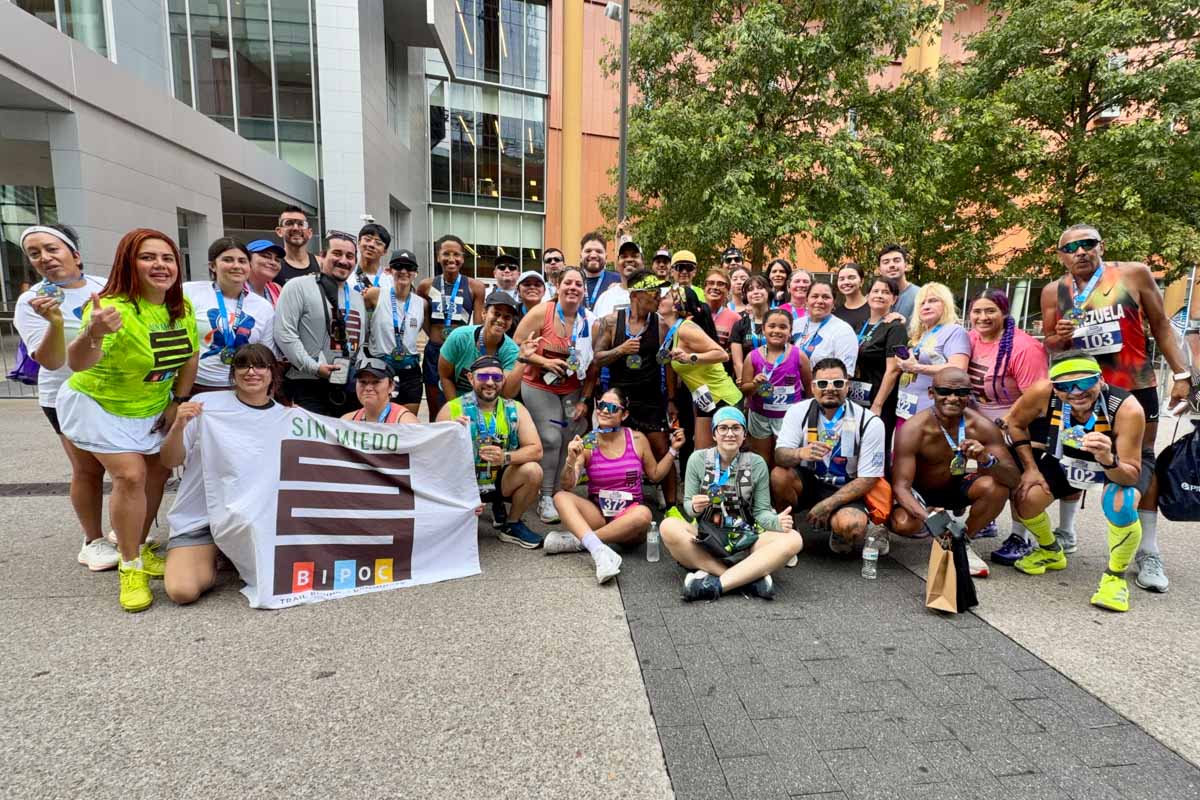
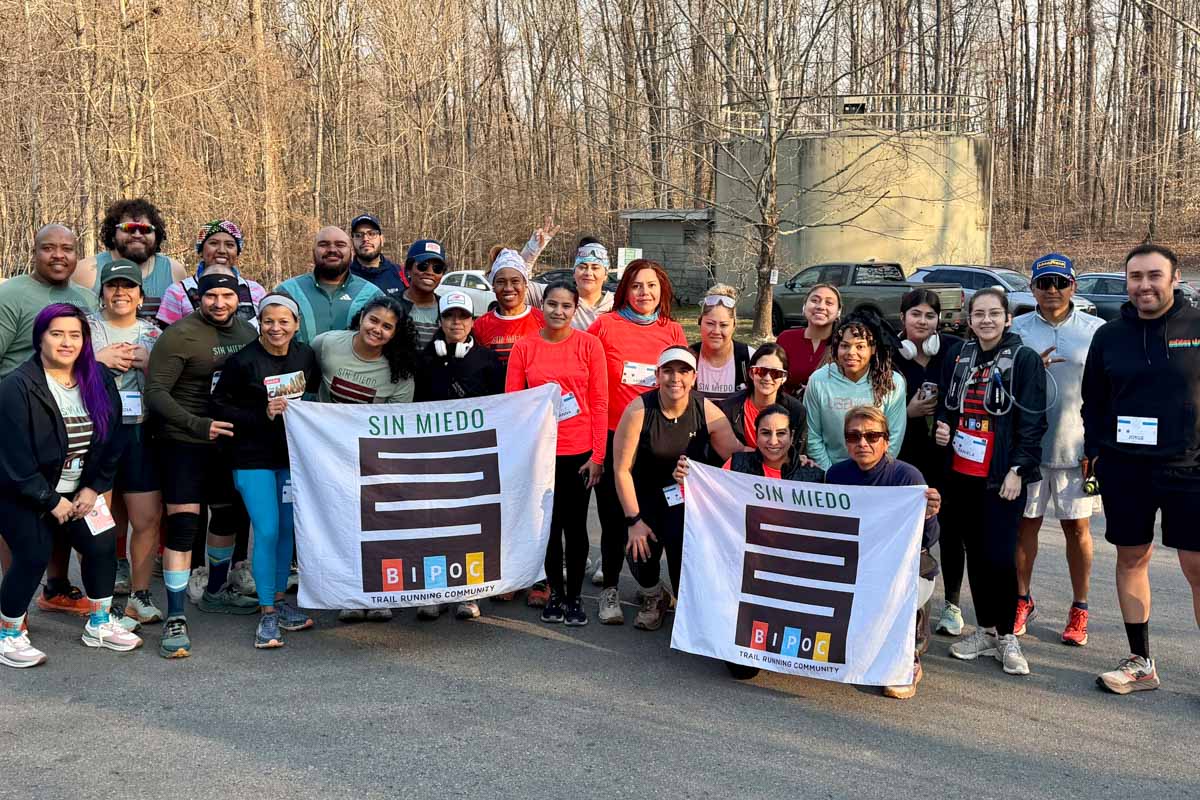
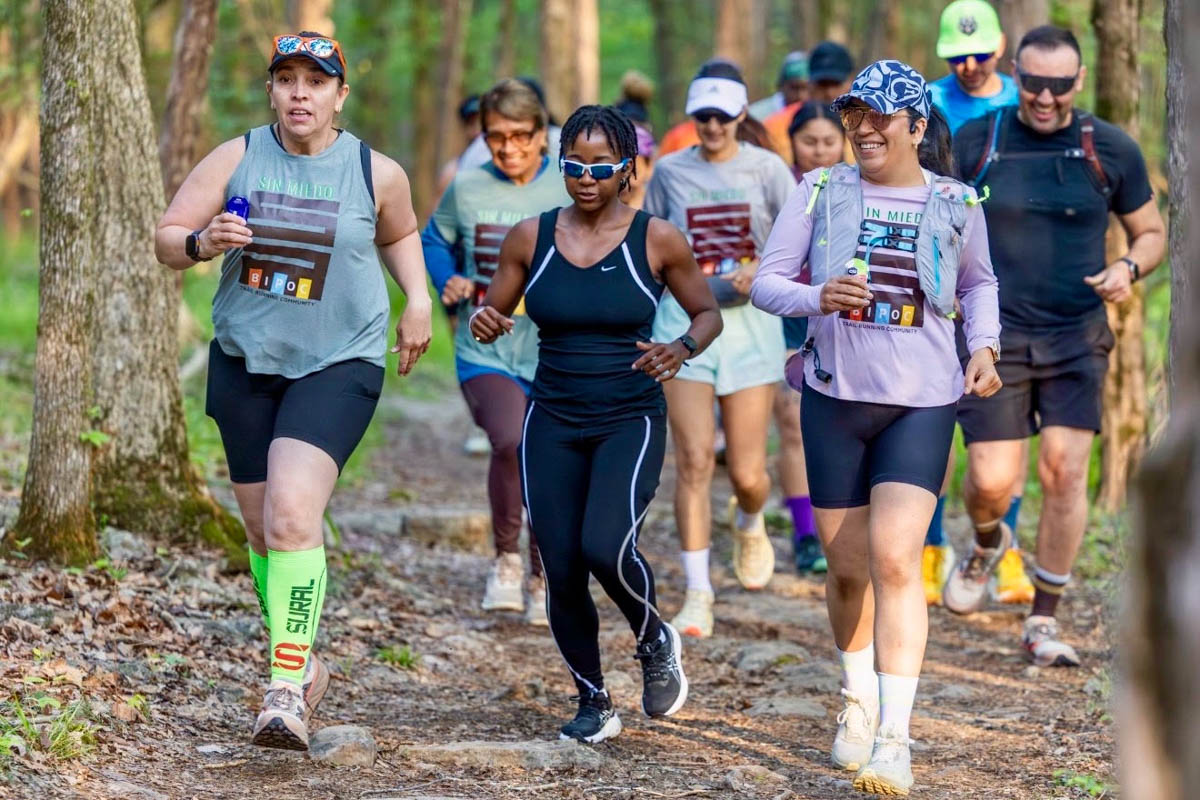
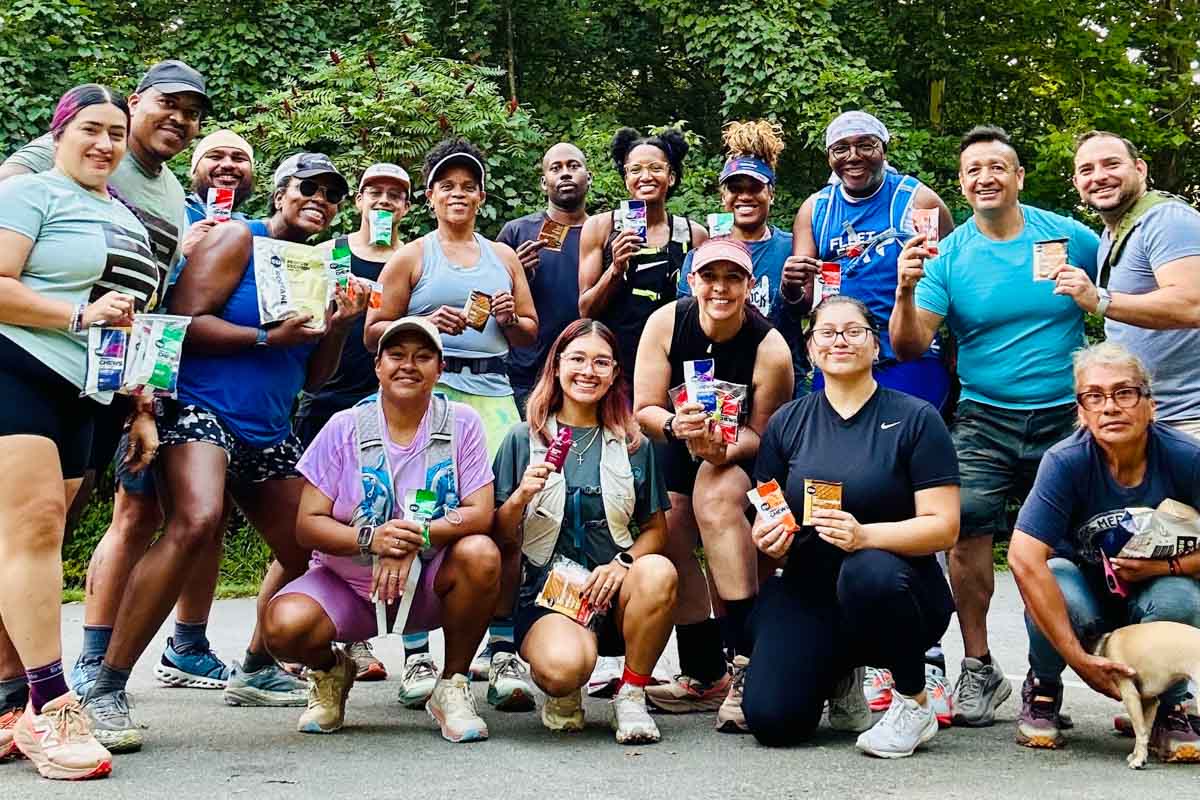
So who are the runners of Sin Miedo? They’re a diverse group of BIPOC athletes, ranging from age 15 to 60-plus, from new runners to podium chasers, running trails and building relationships. They meet every Sunday for group trail runs, and sometimes during the week for road runs. They show up to races with flags and bells, 25 to 35 deep, repeating their mantra: “Run free, run bold, run Sin Miedo.” They attend recovery days with stretching, yoga, and sauna, and demos at local running stores. Most of all, they are a community.
Antoine likes to say, “The doors of the trails are open. Come as you are.”
“And he’s not a man of many words, so that meant a lot, right?” Yolanda said.
Building Community
Building a BIPOC trail running community in the American South, of course, has not been without challenges. Many members carry a deep-rooted fear that cannot be erased, no matter how many times they shout the group’s motto. “Fear comes in a lot of different ways, and just because you’re unafraid to show up doesn’t mean that we’re not dealing subconsciously even with this fear and uncertainty. That doesn’t disappear overnight just because we’re going for a run,” Yolanda said.
Yolanda is aware of the climate the group exists in. “What’s happening around us socially and politically isn’t just something we can just separate from Sin Miedo,” she said. “And so there are people who think differently now about where they go, and who they trust, and what information they share, and whether they feel safe being in certain spaces.”
To help members feel safe, the group never publicly shares its run locations and rotates them frequently. Beyond that, Yolanda said, it’s about letting them know the Sin Miedo community is there for them even if they’re not actively attending runs and events. Members check in on one another and know when to step back. “It has been really important to just focus on our purpose, which is creating the best space we can, so that they can decide that it’s safe,” Yolanda said. “Because I hear that very thrown around: ‘Oh, this is a safe space for you to come to.’ I’m sure it is, but we don’t get to choose that. They get to choose what does safe look like for them.”
BIPOC Representation
Despite the challenges, Sin Miedo is here to stay — and people are taking notice of this growing BIPOC trail running community in Tennessee.
Last year, Yolanda attended the U.S. Trail Running Conference. This year, she’ll be a speaker at it. “Even that, like, ‘Wow, this is where we started. This is where we’re going,’” Yolanda said.
And she knows trail running has a long way to go. She knows the sport needs to embrace the tough conversations. Right now, she said, the conversations surrounding BIPOC access to trail running are too naïve, too delicate. People often become defensive and look for an escape: “Oh, well, not me. Not us. We’re so welcoming. Anybody is welcome here.” “I think that the first thing is to stop assuming that everyone is welcome,” Yolanda said. “That’s not true. And saying everyone is welcome is not the same as creating access.”
Representation, too, is huge. When choosing which races to attend, the Sin Miedo leadership team checks the race website or Instagram for BIPOC runners. Representation is why Yolanda is excited to speak at the conference this year: to show attendees that a Latina woman can be a leader in the industry. “I want people to see me, or even Antoine, whoever, and say, ‘Oh, look! Somebody that looks like me,’” she said.
It’s easy to tell, though, when that representation is forced. Yolanda laughs when she thinks of all of the times she hears from people a week before a heritage month. “It’s like, you know, I’ve been Hispanic the whole year, right?” she said. “That didn’t change.”
Or in advertisements, when it’s clear that the company or organization is simply trying to check a box. “You can put Black and brown runners in an advertisement, but if the person that’s seeing the ad doesn’t know where to go and how to get started, then that’s another barrier to access, right?” Yolanda said. “So it’s not just about finding your token child, and putting them on a poster. It’s including us in the imagery, yes, but also really wanting us there, like we were actually part of it. I think that sometimes one of the things I’ve been saying recently is: Don’t invite us once you’ve already made decisions. Don’t invite us after you’ve already said, ‘All right, so this is the ad we’re going to put out. And I think we need to have this and this and this specific person so that we can depict this or show this.’ Bring us into that conversation. ‘How can we better represent you? How can we better show what the messaging should be?’ And so I think that there has to be more investment to say all that at the community level, especially.”
Finally, there’s the races themselves. Yolanda said there have been times when Sin Miedo shows up with 30 runners and no one from the race organization welcomes them. “We’re not asking for special treatment,” she said. “We’re asking for acknowledgment.”
The solutions she proposed are simple in theory: Put up a sign welcoming large groups, listen to feedback from and build non-transactional relationships with groups like Sin Miedo, and commit to access beyond a single event or heritage month. “There are already Black and brown people who want to run the trails,” Yolanda said. “We’ve seen that firsthand. The industry just doesn’t create the interest in inviting us in. And I think that that’s what’s going to need to happen in order for some of these barriers to access start to kind of go away.”
A Sense of Belonging
For now, though, Yolanda can think about what she and Antoine have built with Sin Miedo. Yolanda recently celebrated her birthday. Sin Miedo made sure it was special.
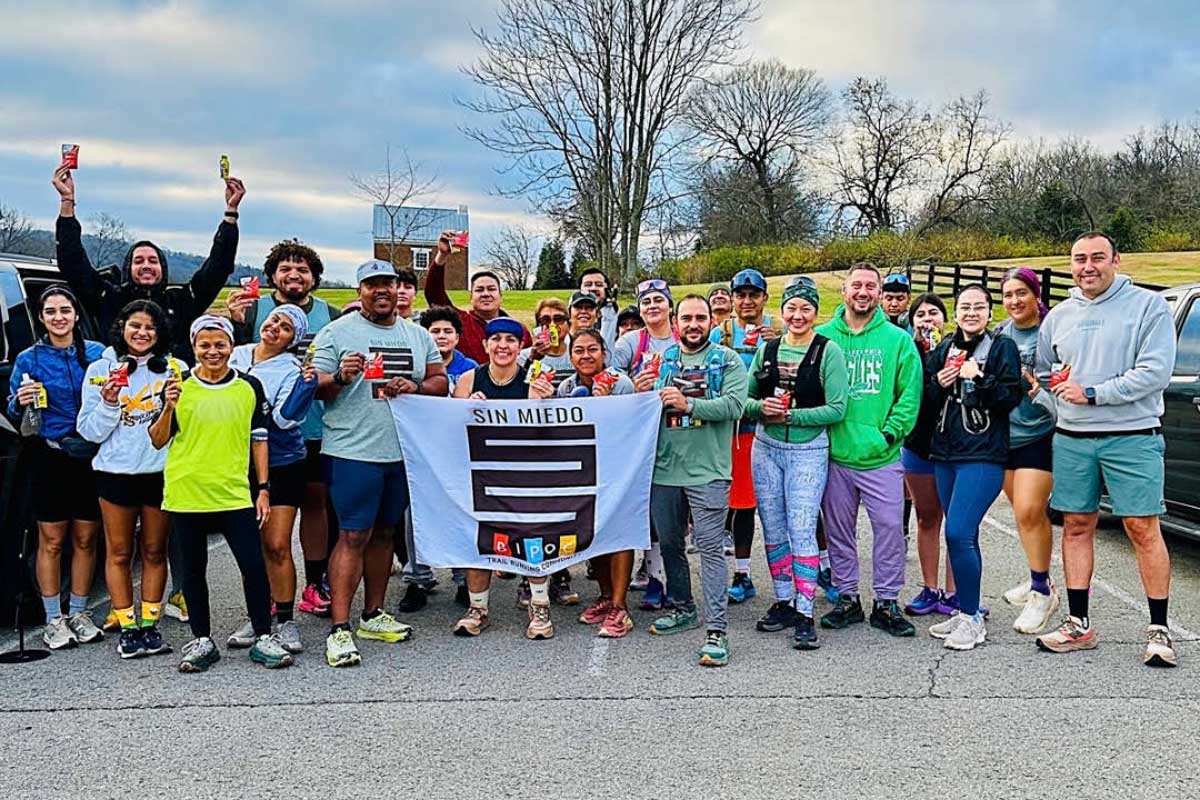
During one of their normal group runs on a recent Sunday morning, members planned a 5k fun run, complete with purple bibs and sashes (her favorite color) and medals. Everyone then went to another member’s house near the trail for what they said was brunch. When Yolanda and Antoine got there, though, the house was empty.
One of the members took them around back, where they had recently built another house to rent. When they opened the door, everyone was there to surprise her. There were photos of her, Polaroid cameras to take more, a cake with a girl running on it, a piñata, karaoke, and tons of food.
“They did too much,” Yolanda said, lovingly. “And I say too much because it’s like, normally, people wouldn’t do this unless they felt like they belonged in your life, and they were part of a community with you.”
Which is, of course, exactly what Sin Miedo has become.
Call for Comments
- Do you have a Yolanda, Antoine, or Sin Miedo story you could share with us?
More Than a BIPOC Trail Run Club: A Profile of Sin Miedo by Robbie Harms.
来源:iRunFar 爱路跑 · irunfar.com